

Welcome to our comprehensive guide on setting up your company in Malta.
Whether you’re a local entrepreneur or an international business looking to expand, Malta offers a favourable business environment and strategic advantages. In this guide, we will take you through the step-by-step process of incorporating your company in Malta, highlighting essential considerations and requirements along the way. By following these guidelines, you’ll be well-equipped to establish a successful presence in Malta.
Company formation fees
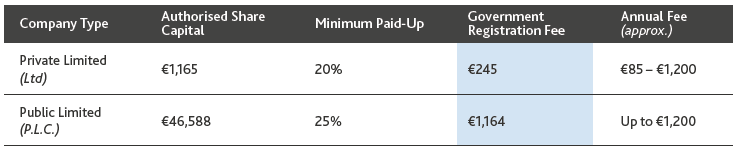
A newly registered limited liability Company with the Malta Business Registry (MBR) would need to pay a one-time registration fee upon submission of the incorporation documentation. Company formation fees are payable to the MBR.
Share Capital Requirements
- Flexibility: BDO ensures you understand these requirements and guides you in selecting the structure that best suits your goals.
- Upon incorporation, the shareholders shall subscribe to at least the said minimum amount, which shall constitute the company’s initial issued share capital.
Incorporation Process & Timelines
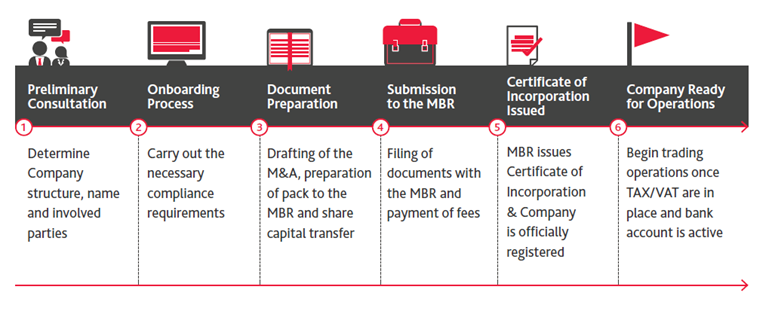
Company formation in Malta is a straightforward process once due diligence is complete. With most documents signed electronically, setup can even be handled remotely. At BDO, we take care of everything from drafting documents to registering with the Malta Business Registry, while keeping you updated with a clear timeline at every stage. Your journey with us typically follows the below steps:
Corporate Governance & Annual Obligations
Running a Maltese company involves a number of ongoing compliance obligations, including filing annual returns with the Malta Business Registry (MBR), maintaining proper accounting records, preparing annual financial statements, complying with statutory audit requirements where applicable, and submitting VAT and payroll reports. The annual MBR filing fee starts at €85 for companies with a share capital of up to €1,500. In addition to these statutory fees, companies should budget for professional accounting, audit (if applicable), and corporate service fees. BDO manages all these ongoing requirements and clearly distinguishes between one-off costs, such as incorporation, and recurring annual expenses, enabling you to plan with clarity and confidence.
Foreign Ownership
Substance & Governance
To benefit fully from Malta’s business environment, companies are expected to have real decision-making and governance locally. BDO helps you meet these ‘substance’ requirements by;
- Providing guidance on board meetings, record-keeping, and local decision-making
- Providing local directors and professionals to meet regulatory expectations
- Providing compliance with substance requirements, critical for tax positioning and corporate governance
Trading vs. Holding Companies
Maltese law does not restrict a company from engaging in both holding and trading activities, allowing a Maltese
registered company to pursue either or both, depending on the shareholders’ intentions.
A Maltese Holding company is generally formed for the purpose of holding one or more assets, including but
not limited to investments in other entities, real estate, investment portfolios, yachts, aircraft as well as intellectual property. A Maltese holding company may benefit from a favourable tax regime, including potential tax exemptions on dividend income and capital gains, making it an attractive jurisdiction for holding foreign investments.
On the other hand, a Maltese Trading company is involved in trading activities, such as the sale of goods and provision of services.
Corporate Taxation
Maltese Trading companies are generally subject to income tax on chargeable income at a standard rate of 35%. However, on the basis of satisfying certain conditions, upon a distribution of such taxed profits, shareholders may claim a 6/7 refund of the Malta tax charge, resulting in an effective tax rate of approximately 5%.
Malta adopts the full imputation system whereby dividends paid by a Maltese company would be entitled to a tax credit of the tax paid upon the distribution of the taxed profits.
Malta Company Types: Public vs Private Limited Companies
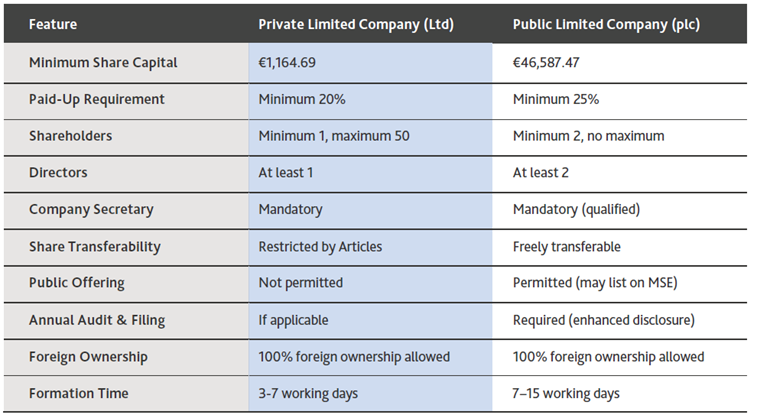
Both Private Limited Companies (Ltd) and Public Limited Companies (plc) in Malta are incorporated under the Companies Act (Cap. 386 of the Laws of Malta). They share the same legal personality and limited liability structure but differ primarily in capital requirements, governance, and public offering rights.
- A Private Limited Company (Ltd) is ideal for enterprises seeking flexibility and limited administrative obligations.
- A Public Limited Company (plc) suits larger structures aiming for public investment, corporate credibility, or listing on the Malta Stock Exchange (MSE).
How can BDO help?
BDO provides end-to-end support for company formation in Malta, guiding clients through every step of the process. We can help with Company Registration, Tax and VAT Compliance, Licensing & Banking, Corporate Governance, Substance & Operational Setup, Directorship and Company Secretary Services, Tailored Advisory. Our approach ensures a smooth, compliant, and strategically sound incorporation process, giving clients confidence from day one.